888 823 5561





September 18, 2026
ISO Course Comparison Factors to Consider Before Enrolling
Selecting the right training program is a critical decision for organizations looking to achieve quality management standards, enhance operational compliance, and upskill their workforce. With dozens of training providers offering varied formats and credentials, conducting a thorough ISO course comparison helps ensure your organization invests in an educational program that delivers real regulatory and operational value. Choosing an accredited course equips your team with actionable skills rather than just a passive certificate.
At Compliancehelp Consulting LLC, we guide businesses across the US—from Boston and Atlanta to Chicago, Dallas, and Los Angeles—toward compliance success. Before enrolling in a class, explore our ISO online course options to find custom training tailored to your industry standards.
Key Takeaways
This guide highlights the essential criteria every business should evaluate before enrolling in an ISO training program:
- Understanding the core differences between course formats and delivery methods.
- Evaluating curriculum depth, ISO standard coverage, and practical exercises.
- Assessing accreditation standards and instructor expertise.
- Identifying post-training support and long-term organizational benefits.
- Utilizing a simple checklist to select the ideal training course.
Evaluating Course Format, Curriculum, and Accreditation
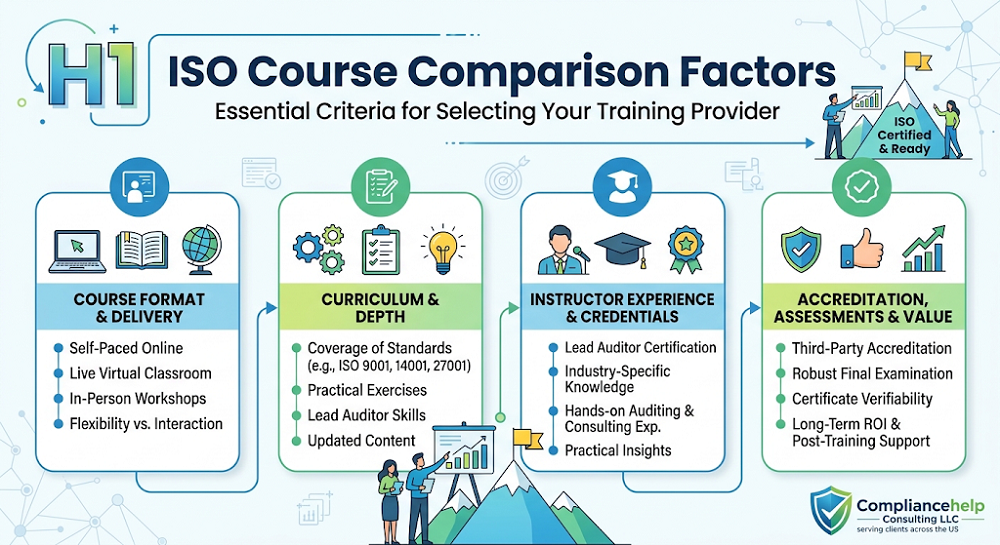
When conducting an ISO course comparison, the first step is analyzing how the training is delivered and whether the content aligns with your operational goals. Course formats generally fall into self-paced online modules, live virtual classrooms, or traditional on-site workshops. Remote teams in tech hubs like Seattle or Austin often prefer virtual delivery, whereas manufacturing plants in the Midwest may benefit from hands-on, on-site sessions.
The curriculum must cover both the core requirements of specific standards—such as ISO 9001, ISO 14001, or ISO 27001—and the real-world application of risk management principles. Beyond syllabus depth, accreditation is essential. Ensure the provider aligns with recognized international or national accreditation bodies so your credentials remain valid during third-party audits.
| Factor | Self-Paced Online | Live Virtual Classroom | On-Site Workshop |
| Flexibility | High | Medium | Low |
| Interactive Discussion | Low | High | High |
| Customization | Low | Medium | High |
| Best For | Individual professionals | Distributed teams | On-site operations |
Instructor Experience and Practical Learning
An ISO training course is only as effective as the expert teaching it. Instructors should hold active lead auditor certifications and possess hands-on consulting experience across relevant industries. An instructor who has managed real audits in healthcare, aerospace, or manufacturing can provide practical insights that go far beyond reading policy documentation.
Practical learning elements are equally critical. Theoretical knowledge alone does not prepare your staff to conduct internal audits or manage corrective action workflows. Look for programs that incorporate scenario-based case studies, mock audits, and interactive group role-playing to build practical confidence.
Assessments, Post-Training Support, and Long-Term Value
Evaluating how knowledge is tested helps guarantee that participants retain key skills. Quality courses utilize continuous assessments, practical assignments, and comprehensive final examinations rather than simple attendance quizzes. Rigorous evaluation ensures that your team is truly prepared to maintain compliance standards.
Post-training support is another major factor in an ISO course comparison. The best training partners provide ongoing learning access, downloadable audit checklists, and direct access to instructors for follow-up questions. This ongoing guidance turns short-term instruction into lasting organizational capability.
Checklist for Selecting the Right ISO Course
Use this quick checklist to evaluate potential training providers before enrolling your staff:
- Verify Accreditation: Is the course recognized by relevant professional bodies?
- Review Instructor Background: Does the trainer have proven lead auditing and industry experience?
- Examine Practical Components: Does the syllabus include mock audits and practical exercises?
- Confirm Ongoing Support: Will participants have access to course materials and experts post-graduation?
- Assess Return on Investment: Does the training equip staff to streamline actual audit workflows?
Frequently Asked Questions
How do I determine which ISO course format is best for my team?
Consider your team’s locations, schedules, and learning styles. Self-paced online options work best for individual professionals who need flexible hours, while live virtual or on-site workshops are ideal for interactive team training and immediate feedback from instructors.
Why is instructor experience so important in ISO training?
Instructors with real-world auditing and consulting experience bring theoretical standards to life. They provide practical context, share industry-specific insights, and prepare your staff to handle real audit scenarios effectively.
What post-training support should an ISO training provider offer?
A quality provider should offer long-term access to course materials, downloadable audit checklists, and direct contact options for follow-up questions. This ongoing support ensures your team can seamlessly apply what they learned back on the job.
Partnering with Compliancehelp Consulting LLC
Performing a detailed ISO course comparison ensures that your investment yields measurable improvements in compliance, internal auditing, and operational efficiency. Choosing a course structured around practical implementation empowers your team to maintain rigorous quality standards with confidence.
Compliancehelp Consulting LLC supports organizations throughout the US, including major business centers like New York, Houston, Denver, and San Francisco. Contact our team today to learn how our tailored ISO solutions can strengthen your compliance framework.